SFB 1361 Alumni Interview
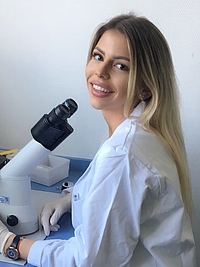
Dr Emina Merdan
Bio-Gram Diagnostics GmbH
What was your main area of research?
During my PhD at TU Darmstadt, my research was focused on the repair of DNA double-strand breaks via non-homologous end joining sub-pathway involving DNA end resection, transcriptional activity, and DNA fill-in synthesis in G0/G1 phase in human cells.
What is your current job?
I currently work as Head of Research & Development at Bio-Gram Diagnostics GmbH. In this role, I lead the development and optimization of diagnostic staining reagents and automated systems, with a strong emphasis on sustainability, quality, and clinical applicability. My work operates at the interface of science, product development, and business strategy.
How did you find this position? What were the career steps you took to get to where you are now?
During the later stages of my PhD, I realized that I was particularly motivated by applied science and real-world impact. Alongside my academic research, I sought exposure to industry-related topics such as manufacturing practices and quality requirements.
I initially joined Bio-Gram Diagnostics as an Application Scientist and later progressed to leading Research and Development. The transition was a gradual process of learning, adapting, and assuming responsibilities beyond bench work. I became aware of this opportunity through my professional network.
Why did you decide not to pursue a career in academia?
I greatly value academia, however, I realized that my long-term motivation lies in seeing tangible outcomes of scientific work within shorter time frames. Industry allows me to combine science with innovation, responsibility, and direct societal impact - particularly in the field of diagnostics, where improvements can immediately affect patient care and laboratory workflows.
What advice do you have for someone getting his or her PhD and looking to pursue a career outside of academia?
The abilities developed during doctoral training - such as critical thinking, problem-solving, resilience, and the capacity to master complex topics - are highly transferable beyond academia. My advice is to start exploring career options early, remain curious about non-academic paths, and actively translate your experiences into a language that industry understands. Finally, never underestimate the importance of networking.