New publication by the Luck and Schick labs on the role of PER-WDR5 interactions in the mammalian circadian clock
Börgel A, Hof F, Welzel M, Rawleigh A, Wedemann M, Mororo Cavalcanti Keller R, Maissl V, Ricci K, Schick S, May-Simera HL, Brown S, Kramer A, Luck K, Ripperger JA, Wolf E (2026) Role of PER-WDR5 interactions in the mammalian circadian clock. Nat Commun, 17:10627 Link
Abstract:
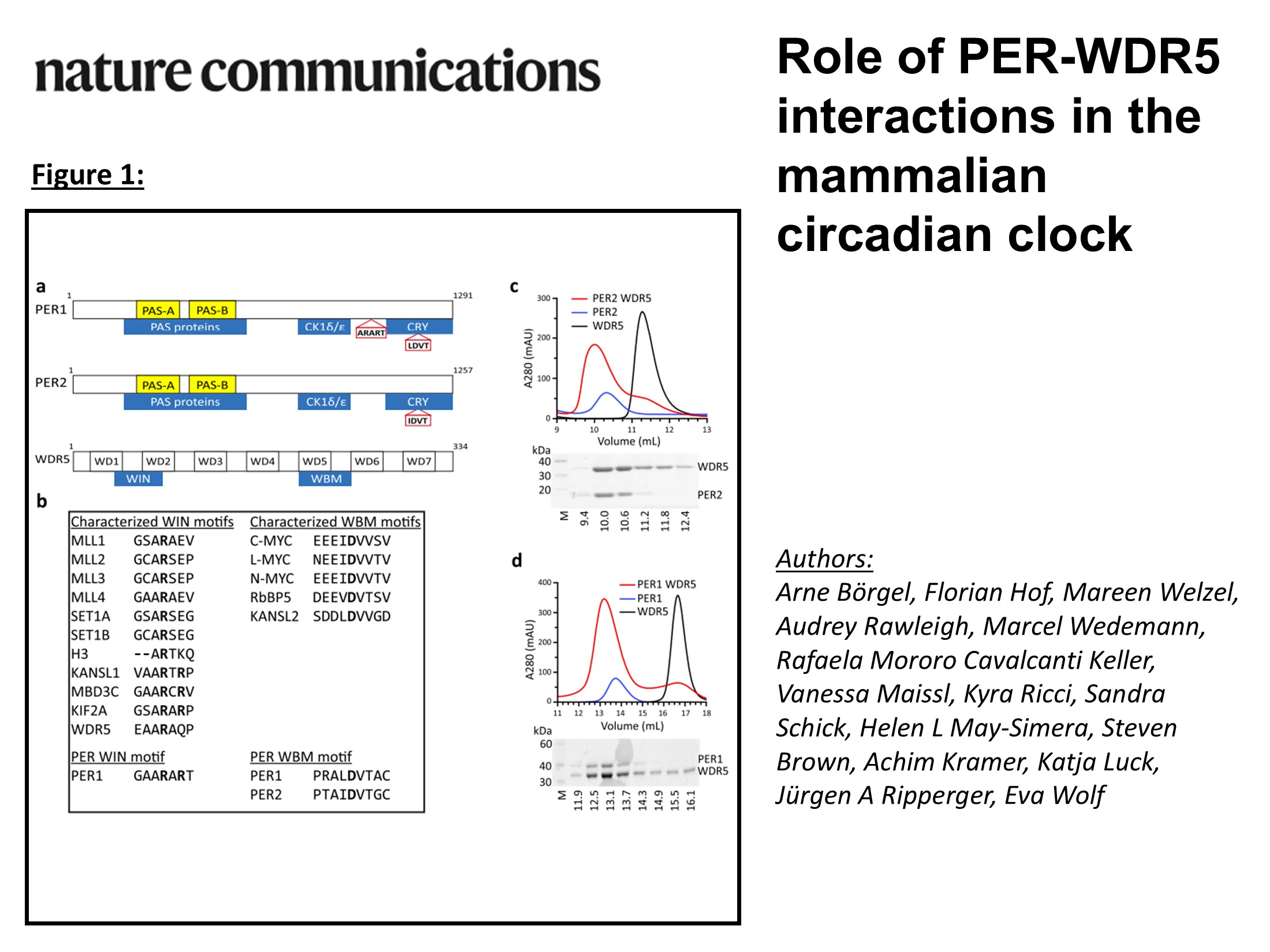
In the mammalian circadian clock, the transcription factor CLOCK/BMAL1 cycles between an active state recruiting co-activators like MLL1 and repressed states associated with PER1/2 and CRY1/2 clock proteins. The MLL1 complex component WDR5 was also found in a repressive PER complex. Here we show that WDR5 directly binds to the CRY binding domain (CBD) regions of PER1 and PER2. PER2 binds WDR5 via a WBM motif within the PER2/CRY interface, imposing competition between PER2/WDR5-, PER2/CRY- and RbBP5/WDR5 complexes. PER1 binds WDR5 predominantly via a WIN motif outside the CBD, enabling formation of trimeric PER1WIN/WDR5/RbBP5WBM - and PER1/WDR5/CRY complexes. WDR5 WIN site inhibitors weaken PER1/WDR5 interactions and impact cellular Bmal1- and Per2 expression dependent on the PER1 WIN motif, likely modulating the primary BMAL1/CLOCK/PER/CRY- and secondary BMAL1/REV-ERB/ROR circadian feedback loop. Together, our studies revealed a role of WDR5 as a direct PER interaction partner with critical differences between PER1 and PER2.
Read the full paper here: https://www.nature.com/articles/s41467-026-77583-0