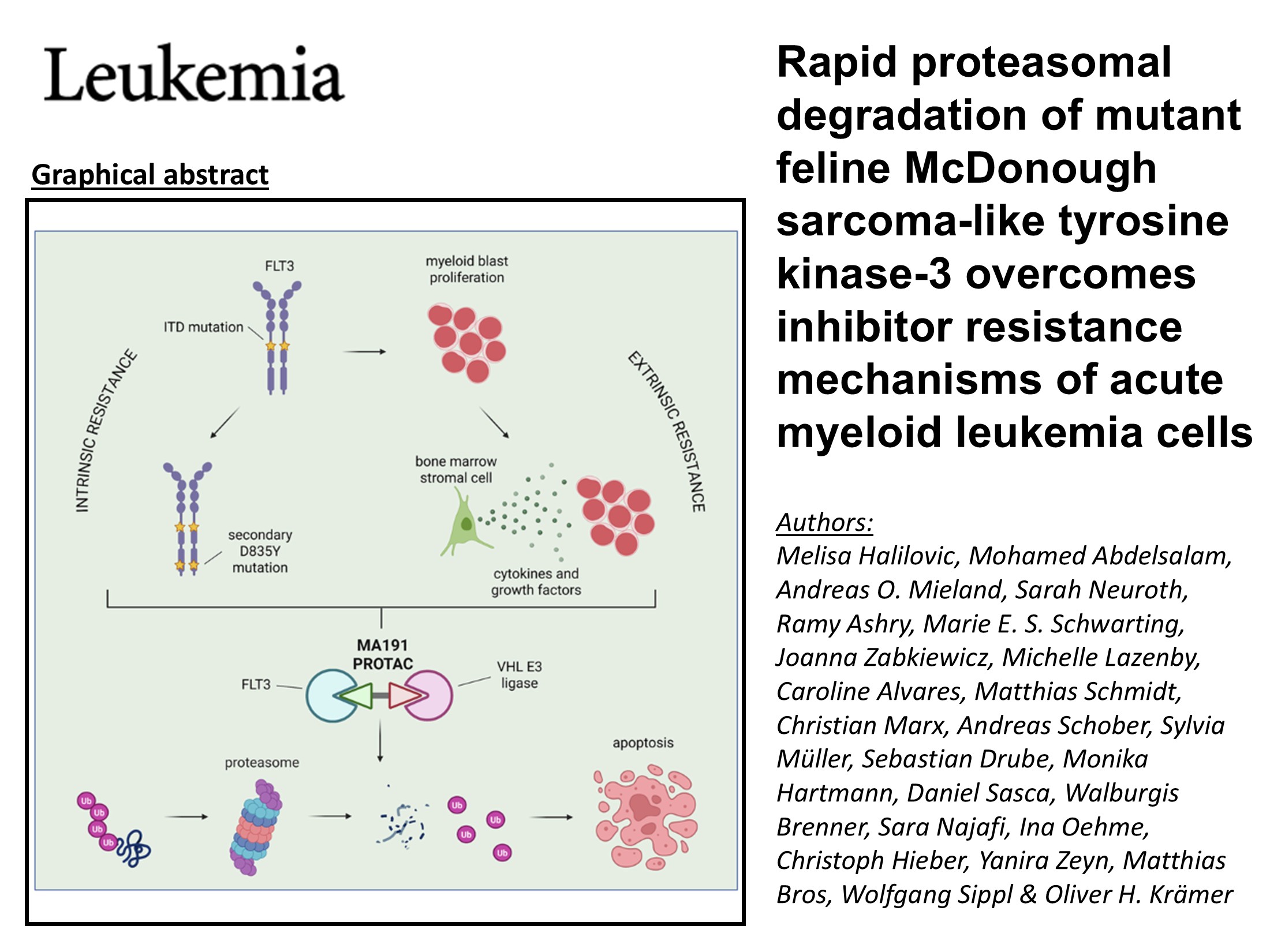
New publication by the Krämer lab on how rapid proteasomal degradation of mutant feline McDonough sarcoma-like tyrosine kinase-3 overcomes inhibitor resistance mechanisms of acute myeloid leukemia cells
Halilovic M, Abdelsalam M, Mieland AO, Neuroth S, Ashry R, Schwarting MES, Zabkiewicz J, Lazenby M, Alvares C, Schmidt M, Marx C, Schober A, Müller S, Drube S, Hartmann M, Sasca D, Brenner W, Najafi S, Oehme I, Hieber C, Zeyn Y, Bros M, Sippl W, Krämer OH (2026) Rapid proteasomal degradation of mutant feline McDonough sarcoma-like tyrosine kinase-3 overcomes inhibitor resistance mechanisms of acute myeloid leukemia cells. Leukemia, doi.org/10.1038/s41375-026-03168-x Link
Abstract:
The hyperactive kinase FLT3-ITD causes acute myeloid leukemia (AML) and is a prognostic biomarker. We synthesized and characterized MA191 as a novel von Hippel-Lindau (VHL) E3 ubiquitin ligase-based proteolysis targeting chimera (PROTAC) for FLT3. MA191 induces apoptosis in cultured and primary AML patient cells harboring FLT3-ITD (IC50=9.6-11 nM; EC50=0.001-0.883 µM). Comparison with a VHL-binding-deficient stereoisomer of MA191 demonstrates that FLT3-ITD degradation is superior to kinase inhibition (p < 0.03). Rapid depletion of FLT3-ITD by MA191 (DC50=10 nM) requires VHL, neddylation, proteasome activity, and the pro-apoptotic BH3-only protein BIM. MA191 reduces FLT3-ITD prior to apoptosis, uncovering apoptosis-independent roles of BIM for protein stability. Higher expression levels of FLT3 in leukemia cells than in healthy cells (n = 3675/n = 1249) are associated with worse AML patient survival (p = 0.0099). MA191 does not harm healthy blood and bone marrow progenitor cells or myeloid cell differentiation. In Danio rerio larvae, MA191 halts AML cell proliferation without significant toxicity. Human stromal cell interactions and mutations in the tyrosine kinase domain of FLT3-ITD that confer resistance to FLT3 inhibitors do not abolish anti-leukemic effects of MA191. Accordingly, leukemia cells with acquired resistance to MA191 lack such mutations. We offer a framework for fast-acting next-generation FLT3 degraders that overcome resistance mechanisms to classical inhibitors.
Read the full paper here: https://www.nature.com/articles/s41375-026-03168-x